Pages

Showing posts with label Palm Sunday. Show all posts

March 25, 2013

The Film of Palm Sunday


Last Sunday was Palm Sunday.
Your reactions to this may well vary, but my feeling about the liturgy of that day
is that it is as singularly powerful as the palm procession and Passion reading are already lengthy;
that too much of attempt to provide elucidation beyond the experiencing of the text itself
can be onerous and problematic;
that it's too easy to say too much and offer too little.

So this year and last, I have provided written homiletical meditations
that seem to provide their own kind of context in people's private meditations at home
or in the silent spaces we offer in tbe service itself.
They're simply inserted into the bulletin.

I say and do this from experience, having earned some of it the hard way.
As usual, your mileage may vary and for the best of reasons.

So anyway, this is what I wrote for Sunday.
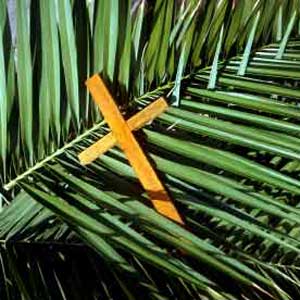

Palm Sunday

Meditation for Year C, Palm Sunday
By The Rev. Torey Lightcap
March 24, 2013
St. Thomas Episcopal Church

The moods shift perceptibly and quickly from scene to scene as we move through Luke’s Passion narrative. Each change of scenery brings a fresh set of perspectives. In the Passion, we go with the narrator through eleven scenes, some of which are only a verse in length:
·  the table (22:14-38)
·  the garden (22:39-53)
·  the courtyard (22:54-71)
·  the places of two trials, one each by Pilate and Herod (23:1-25)
·  the Way of Sorrows (23:26-31)
·  “the place that is called The Skull” (23:32-43)
·  “the whole land” (23:44)
·  the heart of the Temple (23:45)
·  returning to the cross (23:46-49)
·  following Joseph as he bears Jesus to the tomb (23:50-54)
·  following the women of Galilee as they depart (23:55-56)

It’s easy to think we know this story well enough to be able to gloss over it, but that would be an error in thinking. Instead, think of these “scenes” not as individual things but rather as a whole collection of scenes that together make up the story of the passion.

The entire arc of the movie is something like this: the “camera” stays with Jesus and his disciples until the last possible minute before his death. Then the scene shifts to “the whole land” (i.e., the world) and the torn curtain of the Temple (i.e., the visible center of the faith) before returning to Jesus on the cross and his dramatic death. Everything that follows directs our attention to the place of Jesus’ burial, and then to the final scene, when the women walk away, and the camera follows them out. Fade to black. The End.

Here’s something you’ll want to know about the Gospel of Luke. It’s all about the Word of God getting to Jerusalem, and then from there, that Word is meant to be spread widely abroad with all due haste. The Gospel of Luke and the Acts of the Apostles were originally one book, and when you put these two together, it’s easy to see this happening: the Word of God going to Jerusalem (in part one, the Gospel of Luke) so that the movement can be spread to all the world (in part two, Acts of the Apostles). The world, or what Luke calls “the whole land,” is now ripe for the harvest of disciples that is to come. The temple curtain has been torn in two, and God is universally known rather than hidden or (if you will) contained. God, in Christ, is meant to be shared by all.

This is incredibly good news! In an unimaginable death, Jesus the Word of God incarnate makes God “available” to all. To everyone. There are no restrictions as to who will share the riches of God’s grace, life, compassion, and favor. We as followers of Christ must consciously choose each day whether we will enable this flow of grace and life or restrict it – to ourselves, to others, to the world.

The Temple curtain has been torn. God’s life is poured out for the life of the world as Jesus’ life ebbs away on the cross. Holy grace and divine community cannot be restricted, managed, or otherwise imposed upon. Anyone who claims to have a corner on the market and who sells such “secrets” should be questioned and dismissed. God’s mercy is opened and offered freely to all through Jesus Christ.

Today’s liturgy does bring us this message, but it does so in a way that first we have to ride this emotional roller coaster. With palm branches and great pomp, we acclaim Jesus as our king and escort him into Jerusalem. (As Bishop Vono has said of this day, we do love our parades!) And then just as suddenly we put him on trial and find ourselves acting as the anonymous “crowd” whose violent impulses must be satisfied with blood. Then, of course, we see it only halfway through and leave the story dangling where it must stop for now. Since all this only takes a few minutes, we end up compressing a week of Luke into a startlingly small amount of time. Later in the week (our actual week), especially Thursday and Friday, there will be other opportunities to pause the action, ask what it means for us, and pray for guidance. For now, we have to ride this roller coaster.

We are meant to have the sensation of having been through something significant and emotionally draining and a little disorienting. We are supposed to wind up feeling as many of us will – spent, confused, maybe a little guilty.

In other words, dear friends, this is not a “good” day in the conventional sense. Even though there is amazing news about God’s life being so freely extended to each and every one of us without restriction or condition, it doesn’t mean we don’t have to be confronted with the ugly human condition that governs us one and all. These impulses are at war within us.

We need to be able to find the strength to keep going. For this is but the first stop of many this Holy Week.

My prayer for each of you – and myself – is that we find what we need this week in order to be fully present to all that God would have for us.

April 17, 2011

Scapegoat

SERMON FOR YEAR A, PALM SUNDAY

BY THE REV. TOREY LIGHTCAP

SAINT THOMAS EPISCOPAL CHURCH

APRIL 17, 2011

MATTHEW 26:14-27:66

“SCAPEGOAT”


Think of violence like a spiral: broad and general at the bottom, where all the low-lying discontent is … but the higher up you go, the faster and more intense it gets, until finally someone must take the blame, and the hit, and then the cycle slows down and it starts all over again. The man Jesus is a scapegoat, and the spilling of his blood brings an odd sensation of release to the crowds and the authorities who placate the crowds by piercing innocent flesh. Tomorrow, we’ll dig more graves: but for today we have reached our quota, and we’re feeling better about ourselves.


“We.”


We all do this: we all make scapegoats, even, sometimes especially, out of the ones we love, and then, after the deed is done, we deny ever having known them as we warm ourselves beside the fire.


It is not just or fair that Jesus should die – it is not just or fair that we do this. After all, if he is truly the Messiah, the Chosen One, then he of all people should live in order to teach us all the more how to live. His reign should extend into all times and places, and he should be its head – the righteous King on his throne – not only head of those of many years before us, to the people he loved and knew, but to us, too – and to all people, in his flesh – why not? King for all time. Isn’t that what gods do, after all: show us how they’re more powerful than we are?


But that’s not what happens. And again, it isn’t just, and it isn’t fair; but it is sound logic. We need to put our blame on something; and we need to watch as that something is expelled and made to pay the price.


“The … scapegoat,” Jean Chevalier wrote, “stands for the deep-seated human tendency to project one’s own guilt upon someone else, thus appeasing one’s own conscience which always requires some victim to bear responsibility and punishment.”


We need not make anything more or less of it than that at this point. No time. For from here we go running through the thorns: the briars of Thursday, when Jesus is betrayed; the thistles of Friday, when he dies; and the prickles and quills of Saturday, when the grave makes a bed.


Be assured: there is no way to next Sunday without picking our way over these terrible brambles. This is but the first station, and our feet are already bloody because of how hard this teaching is.


I wish with every ounce of energy I possess that I had a shortcut around the thorns, but there’s just no way that can be accounted as faithful.


The first station is done: we all make scapegoats. Let us acknowledge that with Christ as our reigning head, it need not be this way. At least, not among us, his followers.


Amen.

April 2, 2009

Preceding Holy Week, A Humble Desert Mother Speaks

Olympias was a 4th-century Christian deaconess who lived around Constantinople. Her inheritance of a considerable fortune -- the subject of much wrangling whilst in survivorship up until her late 20s -- allowed her to share wealth with the poorest of the poor, construct and establish churches and monastic communities, and enjoy friendship with several of the era's best-known theologians including John Chrysostom, Gregory of Nyssa, and Basil the Great.

Olympias was not just some social player who threw her money around to look good. Any noble bearing others might have ascribed to her on her behalf was clearly rooted in a deep reverence and humility.

One biography described Olympias as having had
a life without vanity, an appearance without pretence, character without affectation, a face without adornment; she kept watch without sleeping, she had an immaterial body, a mind without vainglory, intelligence without conceit, an untroubled heart, an artless spirit, charity without limits, unbounded generosity, contemptible clothing, immeasurable self-control, rectitude of thought, undying hope in God, ineffable almsgiving ...
and ends the description
... she was the ornament of all the humble.
As a priest in the Church, I no longer feel I can afford to imagine that I was ever "needed" to become a presbyter. Certainly I have been able to help in my own small way. For me, I think God needed to put a collar on me so that I might learn a thing or two about humility. Perhaps I was not called so much to the priesthood as to a school for humility.

Not that all priests comport themselves humbly, and not that I do myself -- at least not with any sort of reliability, any kind of regularity or durability. I am aware, but only faintly, of just how much hypocrisy is required for me to even consider publishing a few thoughts on the subject.

Ah, but Olympias, my muse. Ornament of the humble. Spread some light.

We are so close now to Palm Sunday. We will march in procession with our palm branches and hail Jesus in that same manner in which he was used by the crowd to promote dangerous political satire. Then we will race ahead in time a few days (perhaps we can remember what he did in the Temple in between) and listen as he is subjected to crowd taunts and kangaroo courts. Then we will drag ourselves into the courtyard with him, strip him, march him up the hill, and crucify him.

Acclaimed as one thing and killed as another. By us. For us.

Then we do it all over again -- Maundy Thursday, Good Friday. Out of the grave and back in again.

Where is there quarter in any of this for human pride? How can this meta-narrative possibly accommodate our own self-satisfaction?

If we find we can roll down the windows and whistle our way home on days like Palm Sunday and Good Friday, then you have to wonder: What, exactly, did Olympias accomplish?