Pages

Showing posts with label gospel of Luke. Show all posts

March 25, 2013

The Film of Palm Sunday


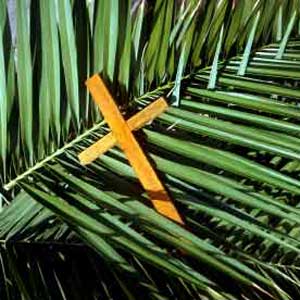
Last Sunday was Palm Sunday.
Your reactions to this may well vary, but my feeling about the liturgy of that day
is that it is as singularly powerful as the palm procession and Passion reading are already lengthy;
that too much of attempt to provide elucidation beyond the experiencing of the text itself
can be onerous and problematic;
that it's too easy to say too much and offer too little.

So this year and last, I have provided written homiletical meditations
that seem to provide their own kind of context in people's private meditations at home
or in the silent spaces we offer in tbe service itself.
They're simply inserted into the bulletin.

I say and do this from experience, having earned some of it the hard way.
As usual, your mileage may vary and for the best of reasons.

So anyway, this is what I wrote for Sunday.

Palm Sunday

Meditation for Year C, Palm Sunday
By The Rev. Torey Lightcap
March 24, 2013
St. Thomas Episcopal Church

The moods shift perceptibly and quickly from scene to scene as we move through Luke’s Passion narrative. Each change of scenery brings a fresh set of perspectives. In the Passion, we go with the narrator through eleven scenes, some of which are only a verse in length:
·  the table (22:14-38)
·  the garden (22:39-53)
·  the courtyard (22:54-71)
·  the places of two trials, one each by Pilate and Herod (23:1-25)
·  the Way of Sorrows (23:26-31)
·  “the place that is called The Skull” (23:32-43)
·  “the whole land” (23:44)
·  the heart of the Temple (23:45)
·  returning to the cross (23:46-49)
·  following Joseph as he bears Jesus to the tomb (23:50-54)
·  following the women of Galilee as they depart (23:55-56)

It’s easy to think we know this story well enough to be able to gloss over it, but that would be an error in thinking. Instead, think of these “scenes” not as individual things but rather as a whole collection of scenes that together make up the story of the passion.

The entire arc of the movie is something like this: the “camera” stays with Jesus and his disciples until the last possible minute before his death. Then the scene shifts to “the whole land” (i.e., the world) and the torn curtain of the Temple (i.e., the visible center of the faith) before returning to Jesus on the cross and his dramatic death. Everything that follows directs our attention to the place of Jesus’ burial, and then to the final scene, when the women walk away, and the camera follows them out. Fade to black. The End.

Here’s something you’ll want to know about the Gospel of Luke. It’s all about the Word of God getting to Jerusalem, and then from there, that Word is meant to be spread widely abroad with all due haste. The Gospel of Luke and the Acts of the Apostles were originally one book, and when you put these two together, it’s easy to see this happening: the Word of God going to Jerusalem (in part one, the Gospel of Luke) so that the movement can be spread to all the world (in part two, Acts of the Apostles). The world, or what Luke calls “the whole land,” is now ripe for the harvest of disciples that is to come. The temple curtain has been torn in two, and God is universally known rather than hidden or (if you will) contained. God, in Christ, is meant to be shared by all.

This is incredibly good news! In an unimaginable death, Jesus the Word of God incarnate makes God “available” to all. To everyone. There are no restrictions as to who will share the riches of God’s grace, life, compassion, and favor. We as followers of Christ must consciously choose each day whether we will enable this flow of grace and life or restrict it – to ourselves, to others, to the world.

The Temple curtain has been torn. God’s life is poured out for the life of the world as Jesus’ life ebbs away on the cross. Holy grace and divine community cannot be restricted, managed, or otherwise imposed upon. Anyone who claims to have a corner on the market and who sells such “secrets” should be questioned and dismissed. God’s mercy is opened and offered freely to all through Jesus Christ.

Today’s liturgy does bring us this message, but it does so in a way that first we have to ride this emotional roller coaster. With palm branches and great pomp, we acclaim Jesus as our king and escort him into Jerusalem. (As Bishop Vono has said of this day, we do love our parades!) And then just as suddenly we put him on trial and find ourselves acting as the anonymous “crowd” whose violent impulses must be satisfied with blood. Then, of course, we see it only halfway through and leave the story dangling where it must stop for now. Since all this only takes a few minutes, we end up compressing a week of Luke into a startlingly small amount of time. Later in the week (our actual week), especially Thursday and Friday, there will be other opportunities to pause the action, ask what it means for us, and pray for guidance. For now, we have to ride this roller coaster.

We are meant to have the sensation of having been through something significant and emotionally draining and a little disorienting. We are supposed to wind up feeling as many of us will – spent, confused, maybe a little guilty.

In other words, dear friends, this is not a “good” day in the conventional sense. Even though there is amazing news about God’s life being so freely extended to each and every one of us without restriction or condition, it doesn’t mean we don’t have to be confronted with the ugly human condition that governs us one and all. These impulses are at war within us.

We need to be able to find the strength to keep going. For this is but the first stop of many this Holy Week.

My prayer for each of you – and myself – is that we find what we need this week in order to be fully present to all that God would have for us.

March 10, 2013

Home


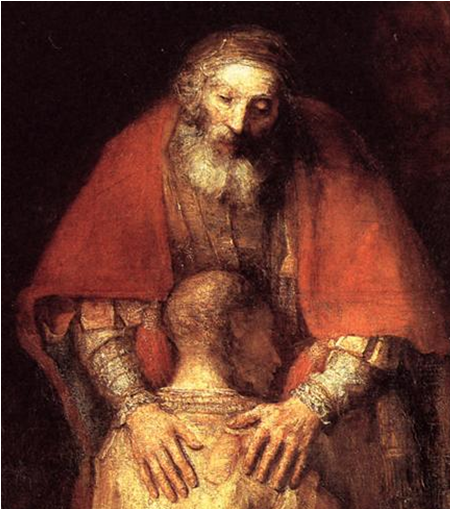
Prodigal Son, Prodigious Father

Sermon for Year C, The Third Sunday of Lent
By The Rev. Torey Lightcap
March 10, 2013
St. Thomas Episcopal Church
“Home”

Ever mess up like this younger brother?
Yeah, me too. Sometimes, just really bad.
So bad I broke everything. Far beyond my own ability to retrieve or to fix.
Boy, can I identify with this younger son:
  Cocky, too big for his britches, ungrateful, unable to see past his own nose.
Get me out of this two-bit town! Do what you have to do!
… What’s that? No, I don’t care what you have to sell off to make it happen.
… What? Oh. No, I don’t care about your long-term situation.
Well. Wait. Okay, I didn’t say that right.
Look, Dad, it’s nothing against you, okay, it’s just …
  I need to go live my life, you know?

There’s a litte place in each of us
  That needs to to buck every bridle placed upon it in a quest to live. Get out and live.
“Faraway places,” “distant countries,” beckon to us from the other side of the globe.
We have to get out, go somewhere, get some distance between us and our pasts.
Hit the road like Jack Kerouack and Allen Ginsberg.
Grace is the last thing on our minds.
Forgiveness”? For what? What’d I do? I’m just trying to live my life.

Some folks leave their house keys on the counter and are never heard from again.
Some enlist or go backpacking, and send home a few postcards of fantastic adventures.
Some head off to college and study hard so they don’t have to think about coming back.
Some find drugs appealing and suddenly everything has to be liquidated.
It’s all just that trip to Vegas we seem to somehow require in some way.
But it exacts a price, eh? It has a heavy toll.
“I have wandered far in a land that is waste,” we say in our rite of individual confession.
The pleasure is momentary; the realization of what we’ve done is painful.
We wake up suddenly, seeing we’ve been marked up with what Jimmy Buffet calls
  A “permanent reminder of a temporary feeling.”

In the 1950s, one of my relatives, my stepfather’s brother, enlisted in the Army
  And went off, I believe, to Korea, or at any rate left his homeland a while.
He was a good man, always was.
He came back with a tattoo.
Of course, I didn’t see that tattoo for several years after the fact,
  'Til it had considerably faded,
    But I’ll bet it was glorious and really meant something the day it was inked on his skin.

One could detect in it old hints of crimson and dodger blue and slate gray –
  A startling prize in its day – quite a thing to tote back to base for the boys to see.

It was of a field of unfolding roses, their petals looking straight up at us,
  The ones in the middle supporting a banner
  On which rested four beautifully crafted letters: V-E-R-A.
I saw the tattoo and reeled at the possibilities,
  But as to who Vera was or had ever been, this uncle of mine gravely swore –
    And I believed him for a long time, and still do because why not? –
  He swore that he honestly could not recall.
He had been married to Nadine, N-A-D-I-N-E,
  Since before he’d ever left home.

For a while, it was probably a daily dose of humiliation
  For him to look into the mirror each morning
  And see the name of someone he couldn’t remember
  Applied so richly to his body.
After ten or twenty years with Nadine, he might go weeks or even months
  Without noticing Vera’s name.
And then he’d be shaving, and catch it in the light just so,
  And the story in all its agonizing detail would collect itself again.
Oh, that’s right. Vera.

No one gets out of a period of poor judgment without some kind of token:
  A tattoo or an ill-fitting wedding ring or a bill for treatment
    Or maybe just a string of relationships we’d rather put behind us.
The point is, we all rebel in some way and we all mess up. Sometimes, royally so.
Many of us hit bottom, wake up, feel stupid, and wonder what our choices are.
Regret, panic, trying to figure out what to do next,
  Wondering how we might get some of it back, get any of it back.
Making plans for how that could possibly happen,
  But also realizing maybe it’s a longshot … maybe I burned my bridges too thoroughly.
That, finally, is how life works. I sure wish it was easier … But there you have it.

Now then.
Have you ever been self-righteously indignant like this older brother?
Have things ever just not gone in your favor, or so you thought,
  Even when you worked hard and tried to be upbeat
  And said all the right things and did your best to get ahead?
Have you ever worked your fingers to the bone and not gotten any recognition for it?
Have you ever watched something completely unfair happen to you,
  When you knew you had no choice in the matter,
  No voice in the process,
    And it was just going to happen anyway whether you wanted it to or not?

Have you ever had the experience of knowing
  That someone was about to go and pour everything you’d worked
  For right down the drain,
    And you had no option but to sit and watch it happen?
Have you ever kicked the dust in anger and frustration
  And said to yourself, You’re darn right I’m mad and I deserve to be!

Church-going folk –
  Especially the ones who would come out in a snowstorm –
  Are prone to this sort of older-brother thinking.
Church-going folk are the ones who keep the trains running on time.
Their shoes are shined like mirrors;
  They know how to do things like balance budgets and unclog toilets;
    They raise their own kids right,
    And they help raise everyone else’s kids right in the process as well.
They bail out their friends when they get in a tight spot,
  And they themselves try to stay out of trouble.
They care, they recycle, they read the paper, and they vote in all the small elections.
They make cookies for bake sales
  And they come up with nonoffensive swear words to say
    When they accidentally hit their thumbs with hammers.
You can set your watch by their haircuts.

To all outside appearances these elder-brothers are functional and happy.
And this is almost always actually the case.
For they have been schooled in how to say a prayer for inner stillness and peace,
  And they have taught their children to Count to Ten.
They have sat at the knees of Sunday School teachers,
  Who have said, without equivocation, that you must treat others
    As you yourself would hope to be treated.
They understand that as Jesus said, the measure you give is the measure you receive.
But under it all, their secret sin is a creeping infestation of anger.
And although in the main they love their lives
  And they say in all honesty they wouldn’t change a thing,
    When they see the world going to waste and burning,
      It makes them not so much sad as angry.
They just want to spit.
“Is there no end of all this poor judgment?”

And … Don’t I have a right to express my feelings of anger and embarassment?
Don’t I have the right – no, the moral obligation!
  To stand up and say this is wrong?
Don’t I? Don’t I matter, too?
I’ve worked hard and I should have a say; I deserve some kind of reward!
It’s not fair!
But more than anything else, this is just embarassing for all of us. So now what?


Have you ever had a moment like the father in this story?
Have you ever lost someone who meant the world to you,
  Who you loved more than you loved yourself?
Someone, perhaps, who took and took and in the end just walked away,
  Leaving a massive hole in your heart?
Have you ever walked the same five feet of floor over and over,
  Wondering where your son or daughter had got off to?

Have you ever had a moment of terrible drama
  When all the anger and frustration and money and time you lost
  Were pushed to the margins
    Just so you could wonder and pray and hope for the return of your precious one?
When all your options for searching had been exhausted
  And your hands were red from wringing and your clothes were stained with tears
    And your feet were weary from prayer
  And nothing else mattered in all the world but just seeing him or her come home?
Knowing that anything else would have to wait?

And what joy! – what incomparable joy leaps up in our hearts
  When at last the lights turn onto our drive or the bus stops in front of our house
    Or the front porch step creaks at 2, 3, 4 in the morning after a weepy night,
    Or after weeks, months, years.
Or the phone rings. Or an email appears out of the blue.

Everything else fades away.
The world recedes; a spotlight appears on your beloved one; the room spins a little.

Of course you forgive. Of course.
Of course there’s a hug and a “Welcome home”
  And an “I love you” and a “We were worried sick”
    And a “We’re not done talking about this but for now I’m just glad you’re alive.”
Of course you forgive. You can’t help it!
It’s your own flesh and blood, lost once, now returned to you.
And frankly it doesn’t matter whether others understand or what they think. Who cares?
Grace and forgiveness and reconciliation flow freely. Tears come easy.

There is a God. It’s not you.
There is a deep, deep longing for return and embrace and Welcome Back;
  And nothing else will do.
Come to your senses and rise up and head for home.
Then, when you’ve been welcomed back,
  Make room for the next refugee, and don’t be angry that he, too, was pardoned.
Just be glad everyone is coming home
  To the arms of the father.

March 3, 2013

Undeserved


fig tree


Sermon for Year C, The Third Sunday of Lent
By The Rev. Torey Lightcap
March 3, 2013
St. Thomas Episcopal Church
“Undeserved”

In the last century there was a Swiss Reformed theologian who did great work.
His name was Karl Barth.
He was an academic, which means that in addition to being a lifelong student himself,
  He was a teacher responsible for helping to form up the next generation of leaders.
Barth was profiled for Time magazine in 1963,
  And in that interview he remembered telling his students to
  “Take your Bible and take your newspaper, and read both.
   “But,” he said, “interpret newspapers from your Bible.”

A newspaper in one hand and a Bible in the other.
The contents of the Bible interpreting and clarifying the contents of the newspaper.
Today, Barth would say, “a smart phone in one hand and a Bible in the other,”
  Or a newspaper in one hand and NPR or CNN or Fox or “The Daily Show” in one ear,
  And the Word of God, sharper than a two-edged sword, coming in from the other side,
    And always, in our reading and hearing, remembering the Bible side,
  Listening for the overlaps, standing in the gaps, and being willing to hear the Gospel
    No matter which side it comes from.
The technology changes, the daily stories change, but the principle remains the same.

Not a bad way to do life. But …
By and large, the church does a disservice to its members by making them think
  That to be able to interpret the Word of God, living and active in the world day by day,
  One needs to have extensive training and specialized knowledge.
I hope you don’t get me wrong –
  It certainly does not hurt to have those things –
    I’ve scraped for mine and benefitted so much from having them –
  But quite often it seems we professional clergy
    Can unintentionally cut people off at the knees when it comes to this
    Because the Word of God is our bread and butter,
      And, we wrongly conclude, because my turf is my turf, it cannot also be yours.
Rather than working to spread the Good News by training folks in how to listen for it,
  Rather than helping to empower, we hoard it, and work at divining it ourselves,
  And that, brothers and sisters, is not good news.
It’s a problem in our work, and it violates the spirit of the priesthood.
So shame on us who wear collars; the Bible is not for professionalizing.

At any rate, when we do see God acting in the world, any person of faith has the duty
  To call immediate attention to it so we can rejoice in it together.
Wherever we see Christ present in the headlines, we point to him, and say, Look here!

Now all of this is some of what Jesus himself is up to today:
  Doing theology on his feet as it were,
  As the headlines roll in, and spreading the wealth of his teaching.
There’s no such thing as a newspaper, of course, in his day,
  And he doesn’t own a Bible
  Because that’s not a concept that’s even been invented yet.
But news is still news: it makes its way around,
  From interested party to interested party,
  Passed about from person to person,
    Until it reaches the ground on which Jesus is standing
    When the folks show up who have news to share.

There’s a breaking story to report:
  “Hey, Jesus, did you hear that Pilate had some people killed
      Right in the middle of their worship?”
“Mingled their blood with their sacrifices” is the precise verbiage,
  Which is a fancy way of saying that all the blood got mixed in together.
This particular sacrifice is an animal sacrifice, but …
  For us, it would be like if I were in the middle of saying the Eucharistic Prayer
  And someone broke in and shot me
    And took some of my own blood and poured into the chalice
    That we say contains the Blood of Christ. “Mingled.” Defiled.
A terrible and dark and humiliating and in-your-face kind of death.
The kind of death that those listening to Luke’s Gospel would have felt as all too real,
  For they too were persecuted and on the run for their belief in Jesus as the Messiah.
Jackbooted Roman soldiers breathing down on them.

“Hey, Jesus, did you hear about this?” The Bible and the newspaper.
There’s a subtle question at play that Jesus wants to bring right up to the surface
  And raise to a level of speech, and not allow to be simply a matter of quiet assumption.
Whenever we hear about someone suffering,
  Sometimes we ask ourselves, very quietly,
  What the person did to deserve it.
It’s not a fair question and we all know that, but human nature is prone to go there.
Jesus answers this question for all time.
Nothing, he says. They didn’t do anything to deserve it. It’s just something that happened.
Something terrible and unnecessary to be sure,
  But they weren’t doing anything to bring down any sort of divine wrath.

It’s an easy trap – magical thinking, I call it, almost voodoo thinking –
  To believe that someone did something so bad that it crossed some invisible line:
  That someone did something deserving of God’s punishment,
    And sometimes we hear it and think to ourselves,
    Well, he had it coming, didn’t he? or Gosh – I wonder what she did to deserve that.
Jesus cautions us today in the strongest possible terms to avoid this kind of thinking.

In our Rite I service, there is a form of confession available to us
  In which we would say,
  “Almighty God, …
    We acknowledge and bewail our manifold sins and wickedness,
    Which we from time to time most grievously have committed,
    By thought, word, and deed,
    Against thy divine Majesty,
    Provoking most justly thy wrath and indignation against us.”
I don’t know what to do with this; but it’s in our thinking, too.

And I guess there are plenty of reasons why we should avoid it.

Yesterday Bobby Knight, the famous college basketball coach,
  Was interviewed on “Weekend Edition,” a radio show, by the host, Scott Simon.
Simon asked Knight, “Why didn’t you have pregame prayers?”
Here’s what Knight said:
  He said, “Well, I’ll tell you what.
  I watched the guy that hits a home run
    And he comes across the plate and he points skyward,
    Like thanking for the help from the Almighty to hit the home run.
  And as he does that, I say to myself God screwed the pitcher.
  And I don’t know how else you look at it.
  You know, I’ve always felt that, you know,
    The Almighty has a lot of things to do other than help my basketball team.”

This is sort of humorous, but it’s also sort of liberating.
We don’t have to play the game of whether we’re worthy before God,
  Or whether our petition, our prayer, our action is worthier than the other guy’s.
We don’t have to play the game at all
  Where God likes the other team better,
  Or God didn’t want my brother to get that job,
  Or God gave my mom cancer so I’m leaving the church,
   Or  God is just never going to be a Cubs fan.
We don’t have to play that game
  Of whether we deserve punishment or favor,
  Whether we deserve to win or to lose.
God roots for life abundant and justice and community.

If Lent teaches us anything, it’s that the Worthiness Game is always a losing game.
It’s a dead-end street, a rabbit trail, a road to nowhere.
Don’t go down it! It’ll waste your time!
We look to the heavens and we ask, Am I worthy, O God?
God wants us to move past this, and to simply lead lives
  That are good and charitable and mutual and that build up the Kingdom of Heaven
  And that show the face of Jesus to friend and stranger alike.

Now, not far from the site of these murders being reported –
  Just steps away, maybe –
  Archaeologists have found the remains of the Tower of Siloam.
Here, too, Jesus finds more fodder for the point he wants to make.
Apparently there was a tower –
  More than likely a tower that was still in the middle of construction –
  And it fell, killing eighteen people.
A moment ripped from recent headlines.
Apparently you just had to say “Tower of Siloam,” and people would have understood
  You were referring to this recent disaster.
Like saying “9/11.” “Columbine.” “Murrah Building.”
Or more accurately, for those who remember those horrific days at Texas A&M,
  The phrase “Aggie Bonfire” would come very close to Siloam:
  Twelve dead and twenty-seven injured in a structural collapse back in 2002.
“Tower of Siloam.” Eighteen people dead in this terrible accident.
And Jesus returns to the quiet thoughts
  That the people must have been amusing themselves with:
  What did those people who were killed do to deserve this?
A thought so natural it’s where we default.
But again, a place of uselessness, gossip, rank speculation.

In the end, his point about the fig tree is quite plain:
  Quit worrying what others did or did not do to appear worthy in God’s eyes,
  And start living lives of your own that meet the standard of the Kingdom of God.
Life is short, as this season of Lent teaches us, and we are finite, mortal creatures.
We will all die someday.
Meanwhile, we’re given a span of time in which to do as much good as possible
  To measure up to the standard of the Kingdom of God.
The Kingdom, you’ll remember me saying often,
  Is not about heaven, pie in the sky, bye and bye, after you die,
  But about bringing the life and work of Jesus Christ to light, in the here-and-now.
It’s an all-encompassing spiritual, civic, economic, and political reality
  In which justice is done and the truth is spoken;
    And, that all, in the end, may come to know the peace of God.
That’s the Kingdom.

From Mark chapter 12:
  “One of the scribes came near and heard them disputing with one another,
    And seeing that Jesus answered them well, he asked him,
    ‘Which commandment is the first of all?’
    Jesus answered, ‘The first is, “Hear, O Israel: the Lord our God, the Lord is one;
    You shall love the Lord your God with all your heart, and with all your soul,
      And with all your mind, and with all your strength.”
    The second is this, “You shall love your neighbor as yourself.”
    There is no other commandment greater than these.’
    Then the scribe said to him, ‘You are right, Teacher; you have truly said that
      “He is one, and besides him there is no other”;
      And “to love him with all the heart, and with all the understanding,
      And with all the strength”, and “to love one’s neighbor as oneself”,—
      This is much more important than all whole burnt-offerings and sacrifices.’
    When Jesus saw that he answered wisely, he said to him,
      ‘You are not far from the kingdom of God.’”

So we have our orders today.
Not to play the Worthiness Game with ourselves or others.
Not to ask, “What did I/you/we/they do to deserve this?”
  But instead to ask, “What can I/you/we/they do to help?”
And once we have the answer, to do it.
The shorthand term for all that is Mission.

It means we set our faces each and every day
  Toward making Jesus’ vision of the Kingdom of God a reality.

So may we all bear this fruit. Amen.