Pages

Showing posts with label Jesus. Show all posts

March 18, 2013

Redolent


Smell Sign

Sermon for Year C, The Fifth Sunday of Lent
By The Rev. Torey Lightcap
March 17, 2013
St. Thomas Episcopal Church
“Redolent”

Let me ask you some questions to get your nose going, okay?

First: what does Christmas smell like?
To me, the smell of Christmas
  Is the smell of sweet rolls … pine … Scotch tape … plums … pie … cinnamon.

What about the Spring? What does springtime smell like?
To me, in my collection of memories,
  Spring smells like grass … chocolate … cleaning products, like window spray.

What are the smells of Summer?
  To me, it’s hot dogs … peanuts … lawnmower gasoline … watering hoses.

What does the Home where you grew up smell like in your mind?
  To me, that home smells like spaghetti sauce in a crockpot … fresh laundry …
    Overly chlorinated water … gun oil … and oddly enough, new carpet.

Every smell is pegged to a memory, or more likely a set of memories.
The more memories there are to reinforce it, the more strongly we can recall it.
Although one harsh memory can forever burn itself into us.

And on that count, since we are approaching the end of Lent,
  And a season of contemplating our mortality,
  I have to ask you this question too:
    What is the smell of death?
As someone who has spent some time in hospitals with dying people,
  I can tell you that a distinct smell arises from a person who is slowly, actively dying.
It’s a kind of sour burning you can taste on the back of your mouth,
  An intrusive and unwelcome smell.
In other deaths that take less time, there are still many smells to contend with:
  The antiseptic smell of hospitals, bad coffee, the cologne of undertakers at 3 a.m.,
    The well-oiled ambulance spilling exhaust, the rubbery tubes used by EMTs … gauze.
When the priest comes, he brings his own smells:
  Holy oil from a stock applied to the head of your deceased loved one,
    Sometimes the hands and the feet also.
Death has its smells.
And I don’t think I have to say this, but I will:
  A dead body has its own particular smells.

I do not say these things in order to turn you off.
I say them because this reading from John
  Is all about what happens in the nose when someone is dead.

Jesus’ friend Lazarus died.
Died for several days as you may recall.
Was in the tomb for four days by the time Jesus showed up:
  Dead long enough that Lazarus’ own sister Martha –
    Martha, you remember, like Martha Stewart, the Domestic Goddess
      Who had no time to sit and listen to Jesus like her sister Mary did –
    Martha warned Jesus that if he raised Lazarus the smell would be horrific.
(So I guess you could say Jesus raised a stink.)
But at any rate, raise him, he did –
  Prefiguring his own resurrection, yes.
And leading us to ponder the power and providence of God,
  That even this could happen.

Now the scene shifts to inside their house,
  And I think it only fair to imagine that the smell of death still hangs heavy on the air.
Lazarus is probably still gobsmacked from having died and been raised up,
  Pondering his good fortune in having Jesus for a friend:
  The one guy in all of history who could pull off bringing him back to life.
At dinner, in the house, the stench of a recently dead man.

Now comes the smell of anointing, and perfume, filling up the house.
In this almost inexplicable act of devotion and sorrow,
  Mary wipes Jesus’ feet with her own hair,
  Spreading the smell of one desiring to anoint Jesus’ body before its funeral.

What Mary cannot know at this moment
  Is that her grief, and the smell that it conveys in this perfume,
  Is actually the gateway to the single most important moment of history,
    Where all time converges and hangs,
    And the bedraggled and crucified Body of the Christ
      Emerges from its temporary earthly tomb, resurrected.
The grief-stricken perfume of anointing which she means to mark Jesus’ death
  Is nothing less than the perfume of life
    That cuts across the smell of death in the house
    Until, finally, there is no more death.

It’s an odd moment, a weird-family-dynamic moment,
  A moment complicated by personal histories and unseen arguments
  That only people who are siblings can really understand between themselves,
    And even then ...

Yet it’s also a small and beautiful moment,
  Heavy with scent and symbol,
  Effusive and intrusive aromas, competing fragrances.

Celebrating the raising of Lazarus.
Anticipating the raising of Jesus.
No tomb can hold them.

Do you know, my dear sisters and brothers,
  What happens in just one week?
It is Palm Sunday. Already, I know.
Palm Sunday, when we welcome Jesus into Jerusalem with great pomp
  And then almost before we know it,
    We are completely caught up with the crowd
      Yelling for Barabbas to be released
    And for Jesus’ blood to be spilled:
      Longing for a scapegoat upon which to heap all our sins.
There is a strong sense, in that service,
  That we are somehow to blame –
    We who were not alive then.
Perhaps we like to think we might’ve done better,
  Warned him off or at least been more loyal than Jesus’ scattered disciples and deniers.
The arc of history and everything we know about mob psychology suggest
  That we need to remain humble.

Soon enough all the smells of Holy Week will be upon us:
  The palms, the oil, the candles, the wine, the bread, the water, the incense and the lilies.
Soon.
But not quite yet.

For now we are in the house with Lazarus,
  Seated between a man who died and a man who will die,
  With the bouquet of the perfume of life heavy in our noses.

We are about to walk a perilous journey.
As we walk it, then,
  Let us remember, as Paul reminds us in Romans, that nothing in all of creation –
    Hardship, distress, persecution, famine, nakedness, peril, sword …
    Neither death, nor life, nor angels, nor rulers …
      Things present, things to come, powers or height or depth …
    Not even the ugly specter of our own grisly desire for a scapegoat …
  That there is nothing that will be able to separate us
    From the love of God in Christ Jesus our Lord.

March 10, 2013

Home


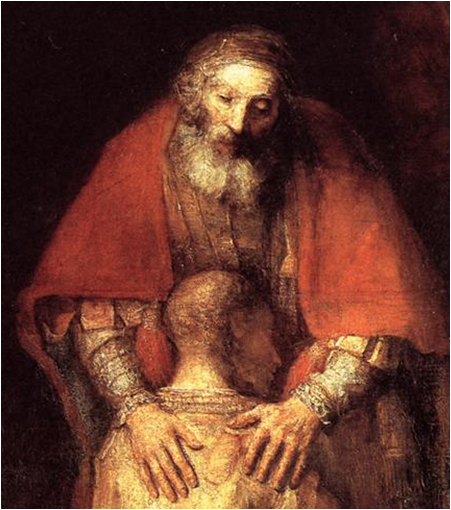
Prodigal Son, Prodigious Father

Sermon for Year C, The Third Sunday of Lent
By The Rev. Torey Lightcap
March 10, 2013
St. Thomas Episcopal Church
“Home”

Ever mess up like this younger brother?
Yeah, me too. Sometimes, just really bad.
So bad I broke everything. Far beyond my own ability to retrieve or to fix.
Boy, can I identify with this younger son:
  Cocky, too big for his britches, ungrateful, unable to see past his own nose.
Get me out of this two-bit town! Do what you have to do!
… What’s that? No, I don’t care what you have to sell off to make it happen.
… What? Oh. No, I don’t care about your long-term situation.
Well. Wait. Okay, I didn’t say that right.
Look, Dad, it’s nothing against you, okay, it’s just …
  I need to go live my life, you know?

There’s a litte place in each of us
  That needs to to buck every bridle placed upon it in a quest to live. Get out and live.
“Faraway places,” “distant countries,” beckon to us from the other side of the globe.
We have to get out, go somewhere, get some distance between us and our pasts.
Hit the road like Jack Kerouack and Allen Ginsberg.
Grace is the last thing on our minds.
“Forgiveness”? For what? What’d I do? I’m just trying to live my life.

Some folks leave their house keys on the counter and are never heard from again.
Some enlist or go backpacking, and send home a few postcards of fantastic adventures.
Some head off to college and study hard so they don’t have to think about coming back.
Some find drugs appealing and suddenly everything has to be liquidated.
It’s all just that trip to Vegas we seem to somehow require in some way.
But it exacts a price, eh? It has a heavy toll.
“I have wandered far in a land that is waste,” we say in our rite of individual confession.
The pleasure is momentary; the realization of what we’ve done is painful.
We wake up suddenly, seeing we’ve been marked up with what Jimmy Buffet calls
  A “permanent reminder of a temporary feeling.”

In the 1950s, one of my relatives, my stepfather’s brother, enlisted in the Army
  And went off, I believe, to Korea, or at any rate left his homeland a while.
He was a good man, always was.
He came back with a tattoo.
Of course, I didn’t see that tattoo for several years after the fact,
  'Til it had considerably faded,
    But I’ll bet it was glorious and really meant something the day it was inked on his skin.

One could detect in it old hints of crimson and dodger blue and slate gray –
  A startling prize in its day – quite a thing to tote back to base for the boys to see.

It was of a field of unfolding roses, their petals looking straight up at us,
  The ones in the middle supporting a banner
  On which rested four beautifully crafted letters: V-E-R-A.
I saw the tattoo and reeled at the possibilities,
  But as to who Vera was or had ever been, this uncle of mine gravely swore –
    And I believed him for a long time, and still do because why not? –
  He swore that he honestly could not recall.
He had been married to Nadine, N-A-D-I-N-E,
  Since before he’d ever left home.

For a while, it was probably a daily dose of humiliation
  For him to look into the mirror each morning
  And see the name of someone he couldn’t remember
  Applied so richly to his body.
After ten or twenty years with Nadine, he might go weeks or even months
  Without noticing Vera’s name.
And then he’d be shaving, and catch it in the light just so,
  And the story in all its agonizing detail would collect itself again.
Oh, that’s right. Vera.

No one gets out of a period of poor judgment without some kind of token:
  A tattoo or an ill-fitting wedding ring or a bill for treatment
    Or maybe just a string of relationships we’d rather put behind us.
The point is, we all rebel in some way and we all mess up. Sometimes, royally so.
Many of us hit bottom, wake up, feel stupid, and wonder what our choices are.
Regret, panic, trying to figure out what to do next,
  Wondering how we might get some of it back, get any of it back.
Making plans for how that could possibly happen,
  But also realizing maybe it’s a longshot … maybe I burned my bridges too thoroughly.
That, finally, is how life works. I sure wish it was easier … But there you have it.

Now then.
Have you ever been self-righteously indignant like this older brother?
Have things ever just not gone in your favor, or so you thought,
  Even when you worked hard and tried to be upbeat
  And said all the right things and did your best to get ahead?
Have you ever worked your fingers to the bone and not gotten any recognition for it?
Have you ever watched something completely unfair happen to you,
  When you knew you had no choice in the matter,
  No voice in the process,
    And it was just going to happen anyway whether you wanted it to or not?

Have you ever had the experience of knowing
  That someone was about to go and pour everything you’d worked
  For right down the drain,
    And you had no option but to sit and watch it happen?
Have you ever kicked the dust in anger and frustration
  And said to yourself, You’re darn right I’m mad and I deserve to be!

Church-going folk –
  Especially the ones who would come out in a snowstorm –
  Are prone to this sort of older-brother thinking.
Church-going folk are the ones who keep the trains running on time.
Their shoes are shined like mirrors;
  They know how to do things like balance budgets and unclog toilets;
    They raise their own kids right,
    And they help raise everyone else’s kids right in the process as well.
They bail out their friends when they get in a tight spot,
  And they themselves try to stay out of trouble.
They care, they recycle, they read the paper, and they vote in all the small elections.
They make cookies for bake sales
  And they come up with nonoffensive swear words to say
    When they accidentally hit their thumbs with hammers.
You can set your watch by their haircuts.

To all outside appearances these elder-brothers are functional and happy.
And this is almost always actually the case.
For they have been schooled in how to say a prayer for inner stillness and peace,
  And they have taught their children to Count to Ten.
They have sat at the knees of Sunday School teachers,
  Who have said, without equivocation, that you must treat others
    As you yourself would hope to be treated.
They understand that as Jesus said, the measure you give is the measure you receive.
But under it all, their secret sin is a creeping infestation of anger.
And although in the main they love their lives
  And they say in all honesty they wouldn’t change a thing,
    When they see the world going to waste and burning,
      It makes them not so much sad as angry.
They just want to spit.
“Is there no end of all this poor judgment?”

And … Don’t I have a right to express my feelings of anger and embarassment?
Don’t I have the right – no, the moral obligation! –
  To stand up and say this is wrong?
Don’t I? Don’t I matter, too?
I’ve worked hard and I should have a say; I deserve some kind of reward!
It’s not fair!
But more than anything else, this is just embarassing for all of us. So now what?

…

Have you ever had a moment like the father in this story?
Have you ever lost someone who meant the world to you,
  Who you loved more than you loved yourself?
Someone, perhaps, who took and took and in the end just walked away,
  Leaving a massive hole in your heart?
Have you ever walked the same five feet of floor over and over,
  Wondering where your son or daughter had got off to?

Have you ever had a moment of terrible drama
  When all the anger and frustration and money and time you lost
  Were pushed to the margins
    Just so you could wonder and pray and hope for the return of your precious one?
When all your options for searching had been exhausted
  And your hands were red from wringing and your clothes were stained with tears
    And your feet were weary from prayer
  And nothing else mattered in all the world but just seeing him or her come home?
Knowing that anything else would have to wait?

And what joy! – what incomparable joy leaps up in our hearts
  When at last the lights turn onto our drive or the bus stops in front of our house
    Or the front porch step creaks at 2, 3, 4 in the morning after a weepy night,
    Or after weeks, months, years.
Or the phone rings. Or an email appears out of the blue.

Everything else fades away.
The world recedes; a spotlight appears on your beloved one; the room spins a little.

Of course you forgive. Of course.
Of course there’s a hug and a “Welcome home”
  And an “I love you” and a “We were worried sick”
    And a “We’re not done talking about this but for now I’m just glad you’re alive.”
Of course you forgive. You can’t help it!
It’s your own flesh and blood, lost once, now returned to you.
And frankly it doesn’t matter whether others understand or what they think. Who cares?
Grace and forgiveness and reconciliation flow freely. Tears come easy.

There is a God. It’s not you.
There is a deep, deep longing for return and embrace and Welcome Back;
  And nothing else will do.
Come to your senses and rise up and head for home.
Then, when you’ve been welcomed back,
  Make room for the next refugee, and don’t be angry that he, too, was pardoned.
Just be glad everyone is coming home
  To the arms of the father.

February 4, 2013

Real


Reality

Sermon for Year C, The Fourth Sunday After the Epiphany
By The Rev. Torey Lightcap
February 3, 2013
St. Thomas Episcopal Church
“Real”

“Surprise! You’re not ready yet!”
That’s the moment I had yesterday.

On Tuesday and Wednesday I wrote what I thought
  Was a fair, clear, fun, grounded, and convincing sermon about this gospel lesson.
It had no fewer than three jokes in it – good ones, too.
It was ready to go.

But you know, sometimes you look at something you’ve done
  And you realize that for some reason it just isn’t what you think it’s supposed to be.
It doesn’t quite sing the way you think it should.
So I threw it all out and started over again.
Less artifice and more truth – that’s what I want and it’s what sits well in my own ear,
  And I think frankly it’s what we all deserve,
    And more than any of that, it’s what God wants. A holy longing. The truth.
If there is a single value to be most embraced in this pulpit, it is to tell the truth.

If I made this confession every time I started over and rewrote a sermon,
  You’d get sick of hearing about it. I’d be a diva.
But it seems to be in the spirit of things that I might call attention
  To this facet of my life this week.
Because getting things down to the level of truth-telling, and only truth-telling, …
  Quite frankly, that’s a tough draw.
Simplicity, sometimes, is the hardest thing.

Have you ever tried to rake your yard when the wind was blowing?
Or tried to dig a hole in soil that was loose and dry?
You can only seem to see what you’re working at for a few seconds at a time,
  And then it sort of slips away unless you keep at it.
The truth can be a little like that, if the lies aren’t regularly bulldozed out.

Jesus gave his mission statement to the crowd in his hometown last week
  And they went nuts over him.
Then, in the exact same moment, in the reading we just heard,
  He cut across their adulation
    And he let ’em have it. Whammo.
He reminded them that a significant portion of their own narrative as a people
  Was of stories about divine punishment and retribution – famines and sickness.

He reminded them of stories about how they had skipped out on God
  And had seen other deities on the side, just like we do.
(Their gods had names like Baal and Rimmon,
  Whereas we’re idolatrous about things that we know aren’t actual gods,
    But perhaps we treat them like they are. Like our phones, maybe.
  This is tricky. For starters,
    Maybe ask yourself if you’re addicted to anything, and if so, What?
      And you’ll be better than halfway to locating the name of your deity.)

At any rate, these stories about people being unfaithful
  Have some pretty grim dimensions, and they draw a bad reaction;
    Jesus reminds his hearers that many widows and lepers died
    Because of how misplaced people’s priorities had been over the years.
That the cause of justice isn’t served when God isn’t served,
  And that by contrast, all he is here to do is to serve God.
I suppose he may even be saying that unlike them,
  He’s planning to be a better example of faith.
So that’s why they don’t like him,
  And that’s why they want to get rid of him.
Hometown boy or not.

See, the miracle isn’t in the depth of his teaching:
  It’s that he’s able to get through to them at all,
    Or, at the very least, that he’s able to get away from them
    When they decide they want to throw him off the cliff and be done with him.

Jesus won’t sugar-coat what he has to say.
For him, it always comes down to “the truth, the whole truth, and nothing but the truth.”
For us it should be the same value.

And that attitude will cost you. Cost you a lot.
There’s no such thing as a convenient gospel …
  Grace that comes cheap …
    A life that doesn’t involve hanging on a cross at least once or twice, maybe a lot.
All of us are misunderstood, reviled, and gossipped about at some time in our lives,
  Maybe a lot.
The difference is, Jesus is willing to go there
  And to pay the price for going there
  If it means getting the whole story out.
All the dimensions of social niceties are insignificant.

Think of all the prophets of the recent age:
  Martin Luther King Jr., Gandhi, Mother Theresa.
Were they interested in public opinion, what people thought about them?
Or did they march forward not caring what others thought, because they saw the truth?

The truth just drills into us, through all our layers of superstition and self-deception.
Right through the armor of social standing and being well-regarded.
The truth exposes the lies we tell ourselves,
  And it dries them up like a sponge so we can’t get them back as easily.

The only protective mechanism we have to fight against the truth
  Is sinking into the crowd, our anonymity in the crowd, our hiding ourselves away
  And finding a scapegoat upon which to heap all our sins.
Drive Jesus out of the synagogue and over a cliff,
  Challenge him in the public square with your best teachers of the law,
    Catch him at midnight in a garden when he’s deep in prayer,
    Take him to the highest courts and try him,
      Or just hang him on a cross until he dies:
  One way or another, human nature will fight the truth as it emerges.

And yet.
There is the undeniable power of naming reality – pulling back the covers on the Real.
In his brilliant letter to the Ephesians,
  Paul says that “everything exposed by the light becomes visible;
  “For everything that becomes visible is light.”
Here’s a plain translation of it:
  Whatever the light touches, itself eventually becomes light.
Truth is like the light.
Whatever it exposes becomes visible;
  And wherever you can see things for what they really are,
  That too becomes a place that has been touched by the truth.
Of course, if we want to hide, repress, and deny it,
  I suppose the capacity to return to the lie always exists if we really want to;
  Nevertheless, the word of God stands fast;
    And when we know the truth, Jesus says, sooner or later it sets us free.

For Jesus, it’s two-sides-of-the-same-coin:
  He says, Let me tell you how it really is –
  The captive will be set free and the eyes of the blind will be opened
    (Is it any wonder he says this last bit? I’m sure that’s for you and me!)
  But, he says, The price you will pay is your denial, your refusal to see life as it is,
    Your rejection and renunciation and disavowal and pretending.
    All these are gods you must give up in the bargain.

Now I suppose it just comes right down to you and me.
What’s not working? …
What are the lies you’ve been hanging on to that you know are lies?
What are the convenient stories and clichés you like to quote to yourself?
What are the things you keep telling yourself to make it all go away one more day?

These things are endless. These lies.
But so is the liberation and the love of God.

Jesus didn’t come to fix everything and soothe every last pain;
  There isn’t a box of Band-Aids big enough.
Instead, he came to take what was dead and to make it alive:
  To resurrect: …
  His close friend Lazarus and the son of the widow of Nain
    And the daughter of Jairus, who was such a bigshot at the synagogue.
He raised them all out of death.

And the kicker, of course, the ultimate resurrection, the raising of Jesus himself.
God did that.
Jesus rose out of death and renewed all of life with him,
  Bringing the light and spreading the truth.

The truth.

That’s all God wanted then, and it’s the same today.

May we learn to trust that God is strong enough
  To bear the burden that we can shuck off
  When we learn to let go and to trust the Holy and the Real.